 (1)_1786514158_WNo_1000d563.webp)
Selecting the right seedling tray can have a significant impact on seedling quality, production efficiency, and long-term farming costs. Whether you need a biodegradable seedling tray for sustainable agriculture or a plastic seedling tray for reliable and repeated nursery production, understanding the differences between these two options is essential.
A biodegradable seedling tray provides an environmentally friendly solution for growers who want to reduce plastic waste and support sustainable planting practices, while a plastic seedling tray offers excellent durability, stable performance, and reusability for commercial greenhouses and large-scale nurseries.
This article will compare biodegradable seedling trays and plastic seedling trays from the perspective of materials, applications, and practical purchasing needs, helping growers, nursery operators, and agricultural suppliers choose the most suitable seedling tray solution for their production goals.
As greenhouse farming, commercial nurseries, and sustainable agriculture continue to develop, seedling tray materials have become an important factor affecting planting efficiency and production costs.
Different materials provide different performances in terms of durability, environmental impact, reuse capability, and application scenarios. Choosing unsuitable seedling trays may lead to problems such as increased replacement costs, unstable seedling growth, difficult transplanting processes, or inefficient nursery management.
Therefore, growers should not only consider the purchase price of seedling trays but also evaluate their crop type, planting cycle, production scale, and long-term operating requirements.
Biodegradable seedling trays are nursery trays produced from environmentally friendly materials such as peat, coconut fiber, paper pulp, wood fiber, and other natural materials. They are designed to reduce plastic consumption and provide an alternative solution for growers focusing on sustainable agricultural practices.
These trays are commonly used in organic farming, eco-friendly planting projects, home gardening, and short-cycle crop production. Some biodegradable trays can be transplanted directly into soil together with seedlings, helping reduce root disturbance during the transplanting process.
_1786514185_WNo_900d429.webp)
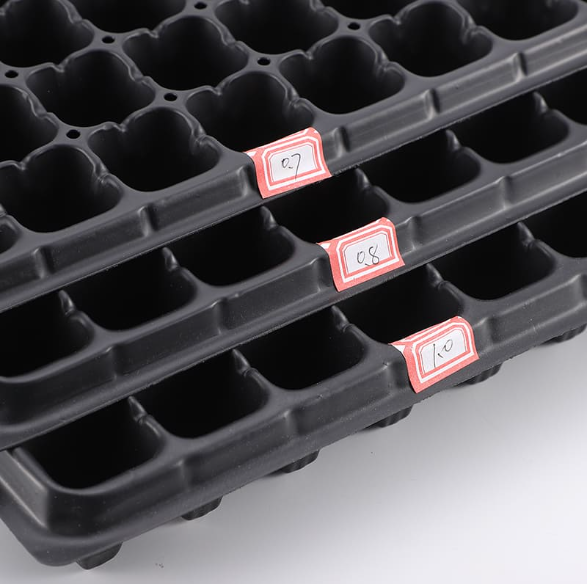
Plastic seedling trays are widely used in commercial agriculture because of their stable structure, durability, and ability to support repeated production cycles. Common materials include PP (polypropylene), PS (polystyrene), and recycled plastics.
Plastic seedling trays are available in different designs, including plug trays, propagation trays, and multi-cell nursery trays. They are suitable for vegetables, flowers, greenhouse cultivation, forestry seedlings, and large-scale nursery operations where consistent seedling quality and production efficiency are important.
| Comparison | Biodegradable Seedling Trays | Plastic Seedling Trays |
|---|---|---|
| Material | Peat, coconut fiber, paper pulp, natural materials | PP, PS, recycled plastic materials |
| Environmental Performance | More suitable for sustainable agriculture and reducing plastic waste | Requires recycling or reuse management |
| Durability | Suitable for short-term planting applications | Strong durability and suitable for repeated use |
| Commercial Production | Suitable for specific eco-friendly farming projects | Suitable for large-scale nurseries and greenhouse production |
| Operating Cost | Depends on material and usage cycle | Lower cost per planting cycle through reuse |
If you need continuous seedling production, stable quality, and repeated tray usage, plastic seedling trays are usually the better choice. Their durability and standardized cell structure make them suitable for professional nurseries and greenhouse operations.
If reducing plastic usage and improving environmental performance are your priorities, biodegradable seedling trays may be more suitable. They are commonly selected for organic farming and environmentally focused planting projects.
If your nursery requires frequent handling, transportation, cleaning, and reuse, plastic seedling trays can provide better long-term economic value due to their longer service life.
If your planting cycle is short and sustainability is more important than repeated tray usage, biodegradable seedling trays can provide an effective solution.
Choosing between biodegradable seedling trays and plastic seedling trays depends on your crops, production scale, planting environment, and long-term goals. Different agricultural applications require different tray structures and material solutions.
Linkwin provides professional seedling tray solutions for different agricultural applications, including biodegradable seedling trays and plastic seedling trays. For growers who focus on sustainable agriculture, Linkwin’s biodegradable seedling trays provide an environmentally friendly option for reducing plastic consumption. For commercial nurseries and greenhouse growers, Linkwin’s plastic seedling trays offer stable performance, durable structure, and reliable support for large-scale production.
Whether you are looking for seedling trays for vegetable cultivation, greenhouse planting, nursery production, or agricultural supply projects, Linkwin can help you select suitable products according to your crop requirements and production conditions.
Contact Linkwin today to explore professional seedling tray solutions and find the right choice for your agricultural production.




We use cookies to make the website work, to provide advanced features, social media and traffic analysis, and we use analytics and third-party advertising cookies. If you choose to click "Deny All", you will retain the default setting of not allowing the use of cookies or other tracking tools other than technical tools.










.png)

.png)



.png)