_1786505625_WNo_1000d563.webp)
With the continuous development of greenhouse farming, commercial nurseries, precision agriculture, and sustainable planting practices, seedling trays have become an important part of modern crop production. For growers and agricultural suppliers, selecting the right tray material is no longer only about purchase cost, but also about production efficiency, seedling quality, service life, and long-term operating expenses.
When choosing plastic seedling trays, many buyers face a common question: should they choose PP seedling trays or traditional PS seedling trays? Different materials have different characteristics in terms of durability, flexibility, production applications, and reuse requirements. Making the wrong choice may increase replacement costs, affect nursery efficiency, or fail to meet specific crop production needs.
This guide will compare PP seedling trays and PS seedling trays from a practical purchasing perspective. By understanding their material characteristics, advantages, limitations, and suitable applications, growers, greenhouse operators, and agricultural buyers can make a more suitable decision when selecting plastic nursery trays for their production requirements.
PP seedling trays are plastic nursery trays manufactured from polypropylene (PP), a thermoplastic material widely used in agricultural products. PP is known for its balanced strength, flexibility, and resistance to repeated handling, making it a popular material choice for professional nursery operations.
PP seedling trays are commonly designed as plug trays, propagation trays, and multi-cell nursery trays. They are available in different cell numbers, such as 32-cell, 72-cell, 128-cell, and 200-cell configurations, allowing growers to select suitable tray structures according to crop type and planting cycle.
For commercial growers who require repeated use, stable performance, and long-term nursery production, PP plastic seedling trays are often selected because they can better withstand daily handling, transportation, cleaning, and reuse cycles.
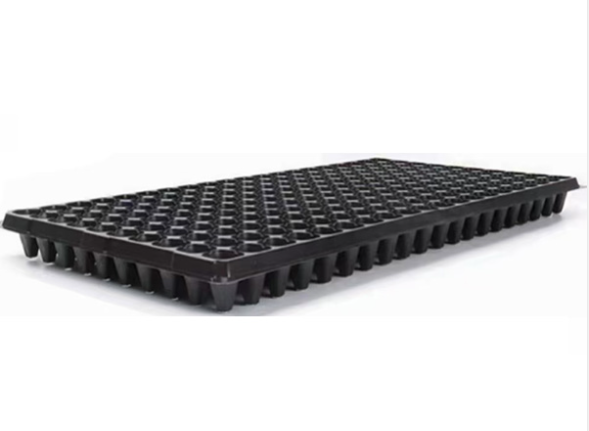
PS seedling trays are made from polystyrene (PS), a lightweight plastic material traditionally used in many agricultural tray applications. Due to its low material cost and easy processing characteristics, PS trays have been widely used for seed starting and short-term nursery production.
Traditional PS seedling trays are commonly available in different cell designs and sizes for vegetable seedlings, flowers, and general nursery applications. They are often selected by growers who focus on initial purchasing cost and large-volume tray requirements.
PS trays are suitable for applications where growers need economical seedling containers for specific planting cycles or short-term production programs.
| Comparison Factor | PP Seedling Trays | PS Seedling Trays | Better Choice |
|---|---|---|---|
| Durability | Higher strength and better resistance to cracking | Lightweight but generally lower impact resistance | PP |
| Reusable Performance | Suitable for repeated nursery cycles | More commonly used for short-term applications | PP |
| Initial Cost | Higher purchase investment | Lower initial cost | PS |
| Commercial Nursery Production | Suitable for professional nurseries and greenhouse operations | Suitable for cost-focused production requirements | PP |
| Transportation and Handling | Better performance under repeated handling | Lightweight and easy to move | Depends on application |
| Long-Term Operating Cost | Lower cost per production cycle due to reuse | May require more frequent replacement | PP |
Choosing between PP seedling trays and PS seedling trays depends on your production requirements, usage frequency, growing environment, and budget considerations. PP trays are known for their durability and repeated-use performance, while PS trays are often selected for lightweight applications and projects where initial cost control is important.
If you operate a nursery that produces seedlings continuously throughout the year, PP seedling trays are usually a more suitable choice. Their strong structure and better impact resistance allow them to withstand repeated cleaning, stacking, transportation, and multiple planting cycles.
They are commonly used in professional nurseries, greenhouse vegetable production, and agricultural businesses that need stable tray performance over long-term operations.
If your priority is reducing tray weight and improving handling efficiency, PS seedling trays can be a practical option. Their lightweight characteristics make them suitable for applications where trays need to be moved frequently or where transportation efficiency is an important consideration.
They can be used for small-scale nurseries, seasonal seedling production, and applications where lightweight trays are preferred.
If your nursery uses automated seeding, transplanting, or handling equipment, PP seedling trays are often preferred because they can maintain stable dimensions and structural integrity during repeated mechanical operations.
They are suitable for growers who require consistent cell sizes, reliable tray positioning, and efficient large-scale seedling management.
If you only need seedling trays for seasonal planting, temporary projects, or short nursery cycles, PS seedling trays can provide a cost-effective solution. They are suitable for growers who do not require frequent reuse and want to control initial purchasing costs.
These trays can be considered for seasonal vegetable cultivation, promotional planting projects, and short-term agricultural applications.
If seedlings need to be transported between different growing areas, greenhouses, or distribution locations, PP seedling trays provide better durability during handling and movement.
Their stronger structure helps reduce deformation risks during transportation, making them suitable for commercial growers and plant suppliers who need reliable tray performance throughout the production process.
If your project has strict budget requirements and tray replacement costs are acceptable, PS seedling trays can be an economical choice. They are suitable for buyers who prioritize lower initial investment and do not require long-term repeated use.
However, users should consider the complete operating cost, including replacement frequency and production cycles, before making the final decision.
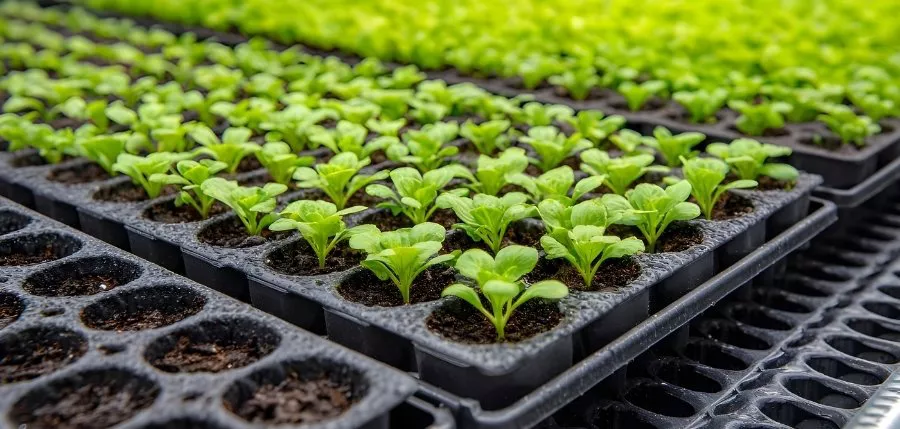
Both PP seedling trays and PS seedling trays have their own application advantages. PP trays are generally more suitable for commercial growers who require durability, repeated use, and stable nursery performance, while PS trays can be a suitable choice for buyers who prioritize lower initial costs and short-term production needs.
Choosing the right seedling tray material can help improve nursery efficiency, reduce unnecessary replacement costs, and better support your crop production goals. The right choice should always be based on your planting scale, crop requirements, and long-term operating plan.
If you are looking for suitable seedling trays for greenhouse farming, vegetable production, or commercial nursery applications, Linkwin provides professional seedling tray solutions based on different agricultural requirements. You can explore more products through seed starting trays or contact Linkwin for recommendations and product consultation according to your specific planting needs.




We use cookies to make the website work, to provide advanced features, social media and traffic analysis, and we use analytics and third-party advertising cookies. If you choose to click "Deny All", you will retain the default setting of not allowing the use of cookies or other tracking tools other than technical tools.










.png)

.png)



.png)