 (1)_1786517034_WNo_1000d563.webp)
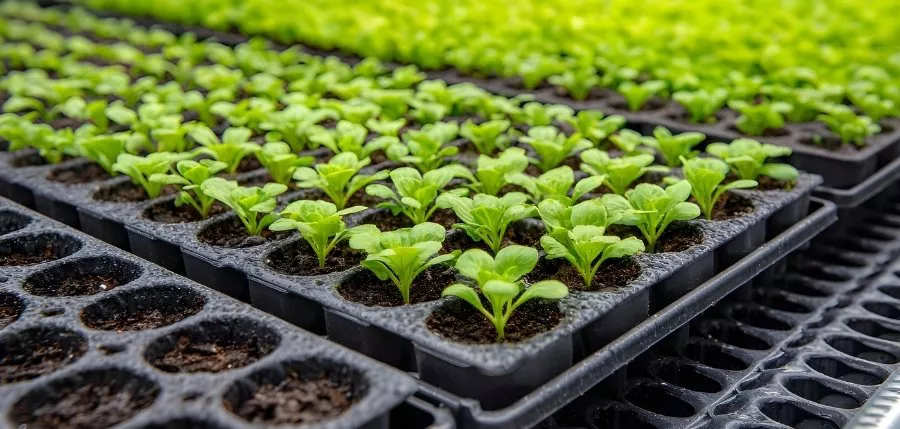
The agricultural industry is moving toward more sustainable production methods. Greenhouse growers, plant nurseries, and agricultural suppliers are increasingly looking for solutions that can reduce environmental impact while maintaining efficient production.
Traditional plastic seedling trays have been widely used in commercial nurseries for decades because they provide stable performance, strong durability, and reliable production efficiency. However, with increasing attention toward recycling and circular economy practices, recycled PET (rPET) seedling trays are becoming a new option for growers who want to reduce dependence on traditional plastic materials.
PET (Polyethylene Terephthalate) is a widely used recyclable plastic material commonly found in beverage bottles and packaging products. Through recycling and processing technologies, used PET materials can be converted into new plastic products, including certain agricultural trays and nursery products.
For nursery operators and agricultural buyers, the biggest question is not simply whether PET seedling trays are more environmentally friendly, but whether they can meet real production requirements. Different crops, planting cycles, greenhouse conditions, and reuse expectations require different seedling tray solutions.
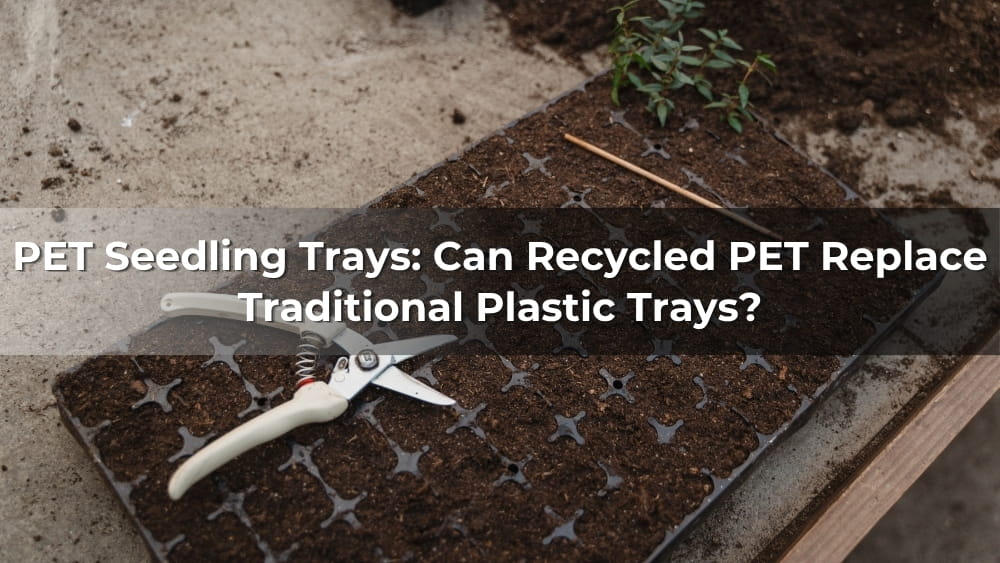
PET seedling trays are nursery trays manufactured using polyethylene terephthalate materials, including recycled PET (rPET). These trays are designed for seed germination, plant propagation, greenhouse cultivation, and nursery production applications.
Compared with traditional plastic trays, PET seedling trays focus more on material recycling and resource efficiency. Recycled PET materials can be collected, processed, and converted into suitable materials for tray manufacturing, helping support a more circular approach to plastic usage.
Depending on manufacturing methods and product design, PET seedling trays can be produced in different structures, including multi-cell trays and propagation trays for different agricultural applications.
_1786517060_WNo_900d429.webp)
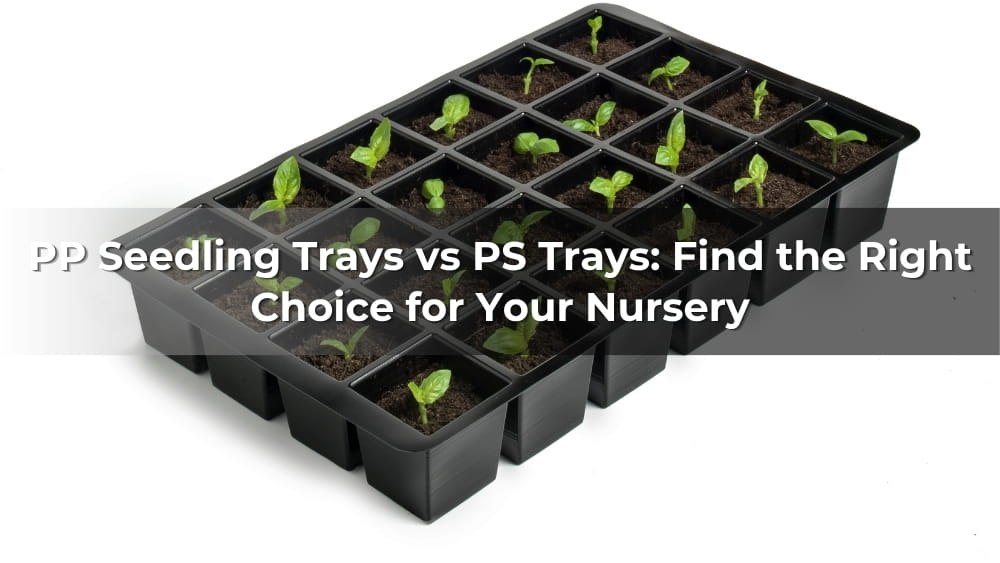
Traditional plastic seedling trays are currently the most commonly used solution in commercial agriculture. They are usually manufactured from plastic materials such as polypropylene (PP), polystyrene (PS), and other recyclable plastics.
These trays are available in various designs, including plug trays, propagation trays, and multi-cell nursery trays. Different cell numbers and tray depths allow growers to select suitable products according to crop type and growing requirements.
For commercial nurseries, plastic seedling trays remain popular because they provide consistent dimensions, reliable drainage performance, and stable mechanical strength during handling, cleaning, transportation, and repeated planting cycles.
| Comparison Factor | PET Seedling Trays | Traditional Plastic Seedling Trays | Recommended Choice |
|---|---|---|---|
| Sustainability | Can utilize recycled PET materials and support recycling-based production | Depends on material selection and recycling management | PET trays for sustainability-focused projects |
| Durability | Suitable for many nursery applications with proper design | Strong durability, especially reusable PP trays | Plastic trays for intensive repeated use |
| Repeated Production Cycles | Depends on tray thickness and manufacturing quality | Widely used for multiple planting cycles | Plastic trays |
| Commercial Nursery Production | Suitable for specific applications | Proven solution for large-scale production | Plastic trays |
| Environmental Requirements | Better fit for recycled material strategies | Suitable when combined with recycling systems | Depends on business goals |
| Material Availability | Depends on recycled PET supply chains | Widely available worldwide | Plastic trays |
_1786517087_WNo_900d429.webp)
The development of recycled PET seedling trays provides growers with a new material option, but it does not mean that PET can completely replace traditional plastic seedling trays in every agricultural application.
For growers who focus on sustainable agriculture and reducing the consumption of virgin plastic materials, recycled PET seedling trays can provide an alternative solution. They allow agricultural businesses to incorporate recycled materials into their production systems while maintaining the advantages of plastic-based products.
However, commercial nurseries usually have higher requirements for seedling trays. Daily operations may include repeated handling, transportation, cleaning, stacking, and multiple planting cycles. In these situations, traditional plastic seedling trays, especially durable PP trays, remain a widely preferred choice because of their proven strength and long-term usability.
Therefore, recycled PET should not be considered a complete replacement for all traditional plastic seedling trays. Instead, PET and plastic trays should be viewed as different solutions for different production goals. The best choice depends on whether your priority is environmental performance, product durability, reuse frequency, or overall production cost.
Choosing between PET seedling trays and plastic seedling trays depends on your crop type, production environment, usage frequency, and long-term operating goals. Instead of focusing only on material differences, growers should first understand the characteristics of each material and select the tray that best fits their specific application requirements.
PET seedling trays are suitable for growers, agricultural suppliers, and brands that prioritize recycled materials and sustainable production concepts. They are a practical option for applications where reducing the use of virgin plastic materials and improving material recycling efficiency are important considerations.
PET seedling trays can be considered for eco-friendly agricultural projects, sustainable product lines, and markets where recycled material solutions are becoming increasingly important. They are also suitable for growers who need lightweight trays with stable forming performance for specific nursery applications.
Plastic seedling trays, especially PP seedling trays, are widely used in professional nurseries and greenhouse production because of their strong mechanical properties, structural stability, and ability to withstand repeated handling.
They are suitable for commercial vegetable production, flower cultivation, greenhouse operations, and nursery businesses that require trays to be cleaned, transported, stacked, and reused through multiple planting cycles.
For growers producing large quantities of seedlings, consistent tray performance and reliable production efficiency are key factors. Plastic seedling trays provide stable cell dimensions, good resistance during daily operations, and compatibility with standardized nursery production processes.
They are commonly selected for crops such as vegetables, flowers, and other plants that require uniform seedling growth and efficient transplanting management.
For agricultural projects that have specific requirements for recycled materials, environmental goals, or sustainable product positioning, PET seedling trays can provide an alternative solution.
However, growers should evaluate factors such as growing conditions, tray design, expected usage cycles, and production requirements before choosing PET trays for their nursery operations.
The best seedling tray material is determined not only by the material itself but also by crop requirements, cell size, tray depth, growing period, and nursery management methods. Different crops and planting environments may require different tray structures to achieve better root development and transplanting performance.
By matching PET or plastic seedling trays with your actual production needs, growers can achieve a better balance between sustainability, durability, production efficiency, and operating costs.
As agricultural production continues to develop toward higher efficiency and sustainability, choosing the right seedling tray supplier is becoming increasingly important. Linkwin provides professional seedling tray solutions designed for different agricultural applications, helping growers select suitable products based on their material preferences, crop requirements, and production goals.
Linkwin offers both PET seedling trays and plastic seedling trays to meet different market needs. For customers who focus on sustainable agriculture and recycled material applications, PET seedling trays provide an environmentally oriented option. For commercial nurseries requiring durability, stable performance, and repeated use, plastic seedling trays remain a reliable choice.
Whether you are producing vegetables, flowers, greenhouse crops, or supplying agricultural products to different markets, Linkwin can help you evaluate suitable seedling tray solutions according to your application requirements.
PET seedling trays and traditional plastic seedling trays are not simply competitors where one completely replaces the other. Each material has different advantages depending on agricultural production requirements.
Recycled PET seedling trays are a suitable option for growers who value sustainable materials and recycling concepts, while traditional plastic seedling trays remain a practical choice for commercial nurseries that require durability, efficiency, and repeated production.
The right seedling tray material should be selected based on your crop type, nursery scale, production cycle, and long-term operating goals. Understanding these differences can help growers improve planting efficiency and reduce unnecessary production costs.
If you are looking for reliable PET seedling trays, plastic seedling trays, or customized nursery tray solutions, please visit Linkwin seedling trays or contact Linkwin for professional consultation and product recommendations based on your agricultural needs.




We use cookies to make the website work, to provide advanced features, social media and traffic analysis, and we use analytics and third-party advertising cookies. If you choose to click "Deny All", you will retain the default setting of not allowing the use of cookies or other tracking tools other than technical tools.










.png)

.png)



.png)